
Blog
Stunt Kites 101: Learning the Lines at Jockey’s Ridge
It’s a hot, cloudless day at Jockey’s Ridge State Park, where deep blue meets pale gold along the rolling horizon of sand dunes. A steady 15 mph wind with 20 mph gusts makes the 90-degree heat feel a bit less intense.
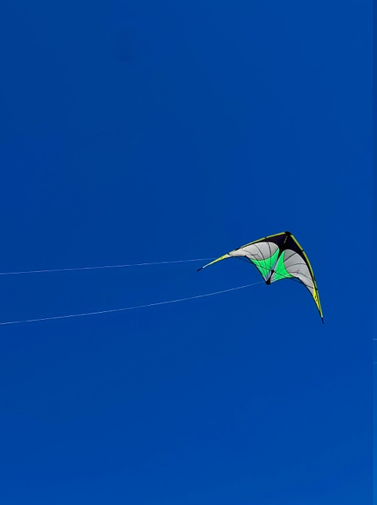
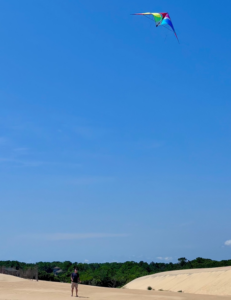
It’s a hot, cloudless day at Jockey’s Ridge State Park, where deep blue meets pale gold along the rolling horizon of sand dunes. A steady 15 mph wind with 20 mph gusts makes the 90-degree heat feel a bit less intense. Maddie Sasser, a 21-year-old stunt kite instructor, carries a long bag as we head to a spot where the wind will be at our backs.
She unfurls the bag to reveal a collection of colorful stunt kites — high-performance, dual-line kites built for sharp turns, spins, and dives. Made from lightweight materials and shaped for speed, they respond to the smallest hand movements.
“I had an 11-year-old doing spins” Maddie says after I admit I’d never heard of stunt kite flying until a few days ago. “It’s such an underrated, accessible activity — we get kids to retirees.”
She lays out a rainbow-colored Prism Quantum, described as beginner-friendly yet high-performing, and connects its frame. The design is crash-resistant and will come apart rather than break at impact — for this novice, a relief to hear.
With the Quantum held in place by a few scoops of sand, Maddie backs up over 100 feet, unspooling the lines. With her elbows tucked at her waist, she takes a few large steps back. The kite lifts into the sky, the wind rippling through its wings with a hum like an outboard motor. She barely moves her arms, yet the kite turns left, then right, then dances — spinning, diving, and soaring. Nearby, a child’s delighted squeal carries over the dunes.
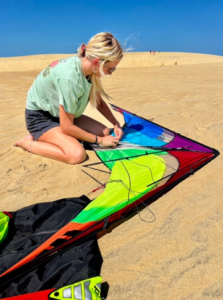
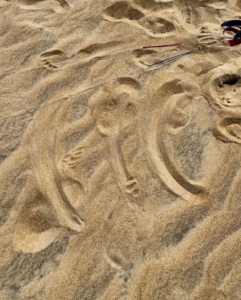
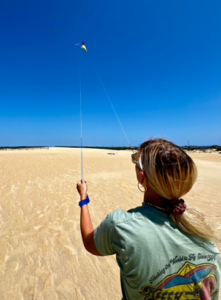
Left to Right: Instructor Maddie Sasser assembles the Prism Quantum stunt kite; flight plan in the sand — the middle line represents the height with the strongest wind, requiring the most control as the kite ascends; Maddie steadies the stunt kite. (Credit: Brian Tress)
Next, it was my turn. Maddie handed me the lines and said, “The instinct to over-correct is huge with beginners. The trick is to relax — little movements — you’re in control.” She reset the kite, and as she let it go, I stepped back and felt the tug of wind — it was airborne!
Seconds later, it crashed in a high-speed nosedive, coming apart on impact. It took several failed launches before I started to settle in. I relaxed my arms, and the kite began to feel like something alive. When the wind pulled it left, I eased my right hand back an inch — it corrected. When it pitched in a gust, I steadied it like a bucking bronco.
Eventually, I attempted a spin — but immediately reverted to a panicked tug that sent the kite into another nosedive. When it finally did spin, skimming the sand with a wingtip, Maddie cheered, “That was beautiful!” I didn’t have the heart to tell her it was a complete accident.
After flying one more kite — a bright green Prism Nexus, lighter and faster than the Quantum — we returned to Kitty Hawk Kites, pleasantly tired, sun-drenched, and dusted with sand.

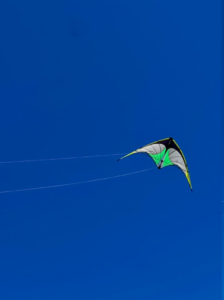
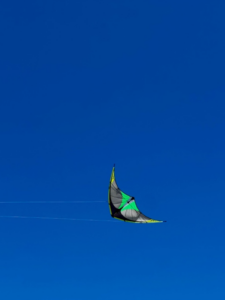
Maddie flies loops with the Prism Nexus stunt kite. (Credit: Brian Tress)
On reflection, it’s easy to see how stunt kite flying can become addictive — there’s no steep learning curve, you don’t need to be a triathlete, and the only gear required is the kite itself, which is a modest investment compared to big-ticket items like hang gliders or surfboards. Many models at Kitty Hawk Kites sell for under $100.
There’s also something quietly magical about it — where a tug on the line feels like a message from the wind: come dance with me.
Written and crafted by Brian Tress
? Ready to Fly? Learn More About Kite Lessons!
?️ Shop the Newest Kites & Accessories Now!
Related Posts
Related stories and guides
More posts from similar categories, selected near this story's publish date.
Kitty Hawk Kites
Published
July 13, 2025

Adventures
Published
July 10, 2025
Kitty Hawk Kites
Published
July 8, 2025