
Blog
Bridging the Past and Future of Flight: An International Aviation Exchange in the Outer Banks
This past weekend, the spirit of aviation history came alive in the Outer Banks as Kitty Hawk Kites welcomed a special international guest for an unforgettable experience centered around the birthplace of flight. From historical tours and educational exchanges to soaring above Jockey’s Ridge, the visit celebrated the enduring connection between early aviation pioneers and the next generation of flight enthusiasts.
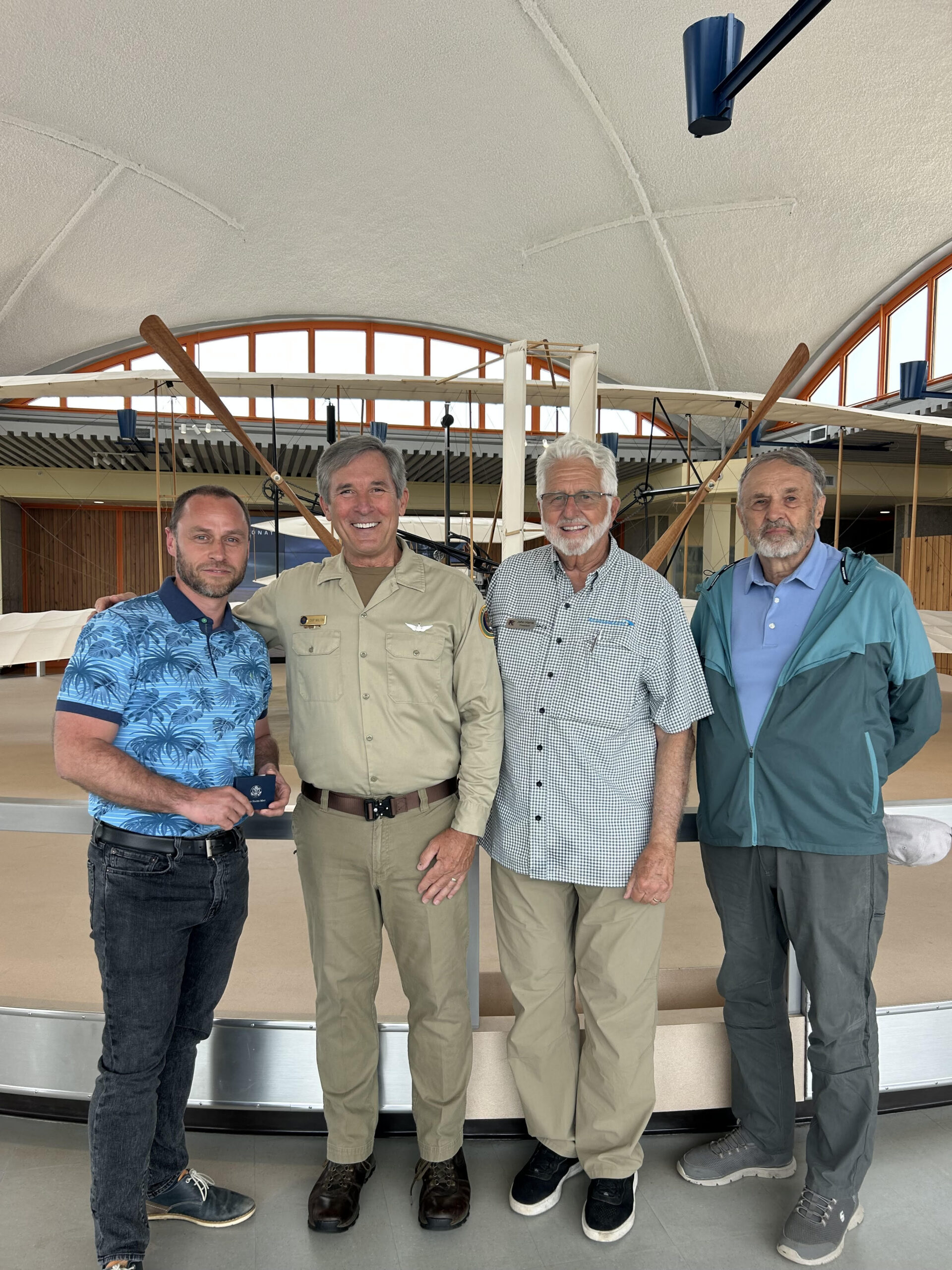
This past weekend, the spirit of aviation history came alive in the Outer Banks as Kitty Hawk Kites welcomed a special international guest for an unforgettable experience centered around the birthplace of flight. From historical tours and educational exchanges to soaring above Jockey’s Ridge, the visit celebrated the enduring connection between early aviation pioneers and the next generation of flight enthusiasts.
At the center of the visit was Dr. Peter Busse, Director of the Otto Lilienthal Museum, who traveled to the Outer Banks to explore the birthplace of powered flight and strengthen connections with the local aviation community. During the visit, discussions began surrounding the possibility of bringing two German students affiliated with the museum to participate in the First Flight High School Aviation Program next year.
Their visit highlighted the remarkable relationship between German aviation pioneer Otto Lilienthal and the Wright Brothers — a connection that helped shape the future of aviation and eventually inspired modern hang gliding itself.
The Pioneer Who Inspired the Wright Brothers
Long before powered flight became reality, humans across the world were searching for a way to safely fly. Among the most influential of these early pioneers was German engineer and inventor Otto Lilienthal.
Born in 1848, Lilienthal dedicated much of his life to studying the mechanics of bird flight and understanding how humans could glide through the air. At a time when many aviation concepts existed only on paper, Lilienthal turned theory into action. During the 1890s, he completed more than 2,000 documented glider flights using aircraft of his own design, becoming the first person to successfully perform repeated, controlled flights.
Lilienthal carefully recorded his experiments, observations, and aerodynamic findings, publishing detailed data about lift, wing curvature, balance, and flight control. His work became some of the first truly scientific studies of human flight.
These findings would eventually land in the hands of two bicycle mechanics from Dayton, Ohio: Wilbur and Orville Wright.
The Wright Brothers were fascinated by flight from a young age, but unlike many inventors of the era, they approached the challenge scientifically. After studying the failures and successes of earlier aviation pioneers, they became especially interested in Lilienthal’s research. In fact, Wilbur Wright once stated:
“Of all men who attacked the flying problem in the 19th century, Otto Lilienthal was easily the most important.”
The brothers used Lilienthal’s aerodynamic data as the starting point for their own experiments. However, they soon discovered some inconsistencies in existing flight calculations, which pushed them to build their own wind tunnel and conduct groundbreaking aerodynamic testing of their own.
This careful experimentation eventually led the Wright Brothers to solve one of aviation’s greatest challenges: controlled flight.
From Gliders to Powered Flight
Unlike many inventors who focused solely on engines and power, the Wright Brothers believed mastering control was the true key to flying. They developed innovative techniques for steering aircraft, including wing warping, movable rudders, and elevator controls — systems that became the foundation of modern aviation.
Between 1900 and 1902, the Wright Brothers traveled repeatedly to the Outer Banks to test their gliders in the strong, steady winds and soft sand dunes of Kitty Hawk and Kill Devil Hills. Their glider experiments directly built upon the work Lilienthal had started years earlier.
Then, on December 17, 1903, history changed forever.
At Wright Brothers National Memorial, Orville Wright piloted the first successful powered flight in the Wright Flyer while Wilbur ran alongside the aircraft. The flight lasted just 12 seconds and covered 120 feet, but it marked the beginning of the aviation age.
That first powered flight was not the end of Lilienthal’s story — it was the continuation of it.
Continued Innovation- Francis Rogallo
The influence of both Lilienthal and the Wright Brothers can still be felt every day in the Outer Banks skies.
Decades after the Wright Brothers achieved powered flight, engineer Francis Rogallo introduced the flexible Rogallo wing, a revolutionary design that became the basis for modern hang gliders. Much like Lilienthal’s original gliders, Rogallo’s wings relied on simple aerodynamic principles and weight-shift control to allow pilots to soar naturally with the wind.
Today’s hang gliding pilots continue a lineage that stretches back more than a century — from Lilienthal’s hillside glides in Germany, to the Wright Brothers’ experiments in Kitty Hawk, to the recreational flying community that thrives on the dunes of Jockey’s Ridge State Park today.
That legacy is also preserved through the work of the Francis Rogallo Foundation, a nonprofit organization dedicated to honoring Rogallo’s contributions to flight and supporting the future of free-flight aviation. The foundation helps preserve hang gliding history, promotes aviation education, and supports projects and programs that inspire new generations of pilots and aerospace enthusiasts.
Donate to help us preserve his legacy!
Inspiring the Next Generation of Aviators
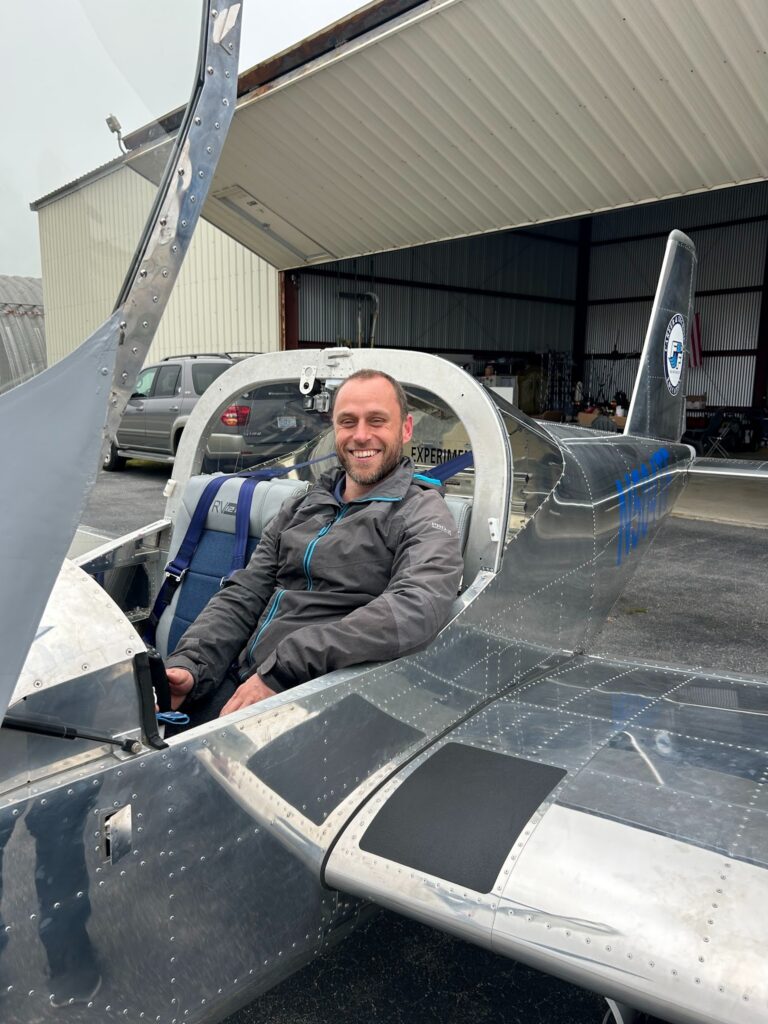
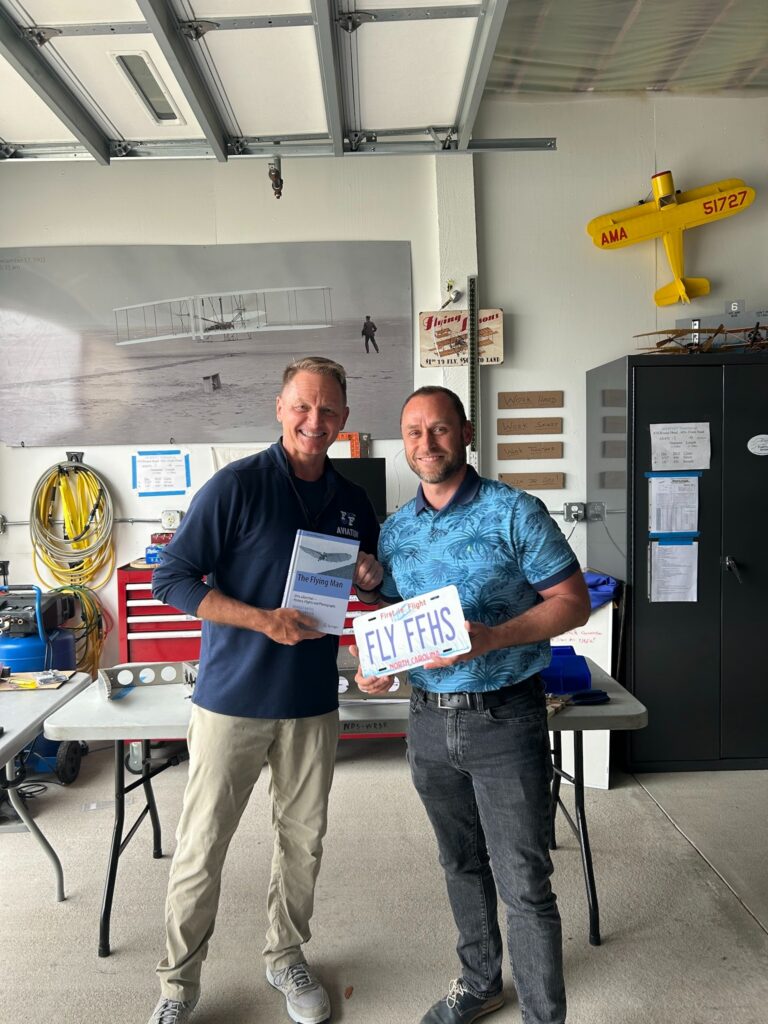
The visit also included a presentation from the First Flight High School Aviation Program led by Shannon Castillo and Admiral JT Tynch.
The aviation program offers juniors and seniors a unique hands-on opportunity to explore the aviation industry through real-world experience. With around 20 students enrolled, the optional program goes far beyond textbooks — teaching students about mechanics, aviation history, piloting, aircraft systems, and engineering through the process of building a real aircraft over the course of approximately two and a half years.
Using materials and curriculum provided by the nonprofit Tango Flight, students learn not only how airplanes are assembled, but also the science behind flight itself. Understanding aerodynamics and aircraft design allows students to better appreciate the decisions made by pioneers like Lilienthal and the Wright Brothers more than a century ago.
One of the most impactful aspects of the program is how it exposes students to aviation careers they may never have previously considered. Students often discover specific interests within the building process — whether mechanics, design, piloting, or engineering — helping them identify future career paths and passions.
As Admiral JT Tynch challenged students during the presentation:
“Why not you? Why not now?”
The program has already graduated two classes and helped guide 22 students toward futures connected to aviation and related industries. Castillo and Tynch also emphasized the vital role the Outer Banks community plays in supporting the future of flight, with local businesses and residents contributing resources and encouragement to help students succeed.
During the exchange, Dr. Busse expressed interest in potentially bringing two students associated with the museum back to the Outer Banks next year to participate in the aviation program — creating an exciting opportunity for international collaboration rooted in aviation history and hands-on flight education.
To commemorate the visit, the aviation program and Dr. Busse exchanged gifts as a symbol of shared passion, education, and international friendship through flight.
Taking Flight with Kitty Hawk Kites
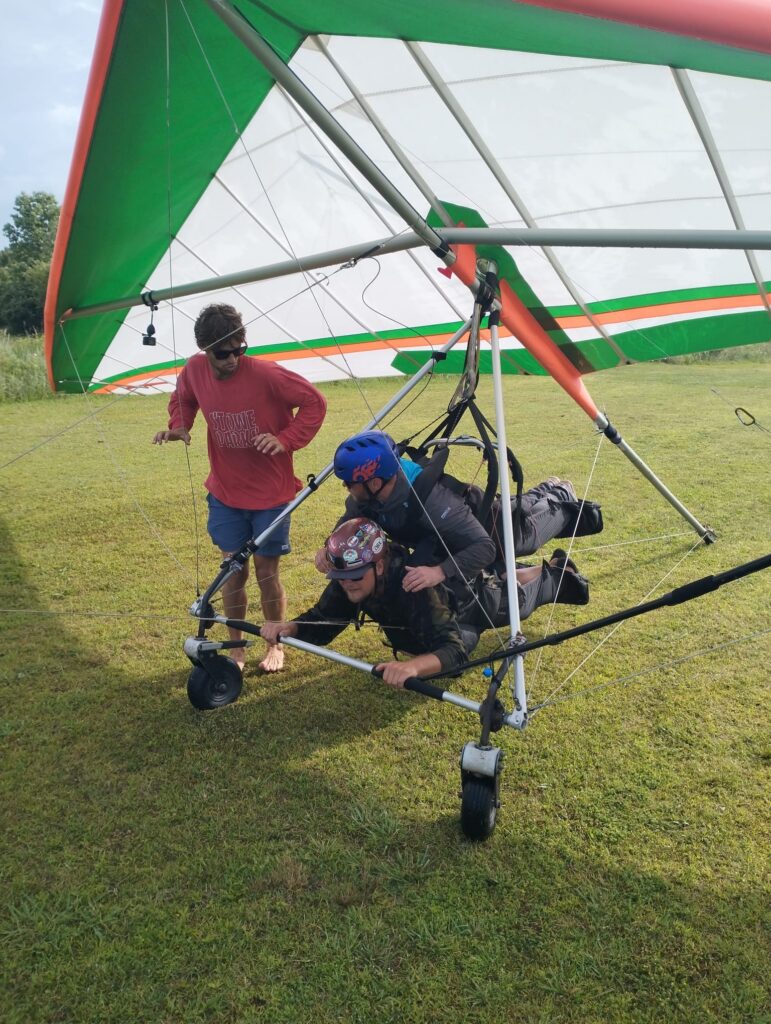
Of course, no aviation visit to the Outer Banks would be complete without experiencing flight firsthand.
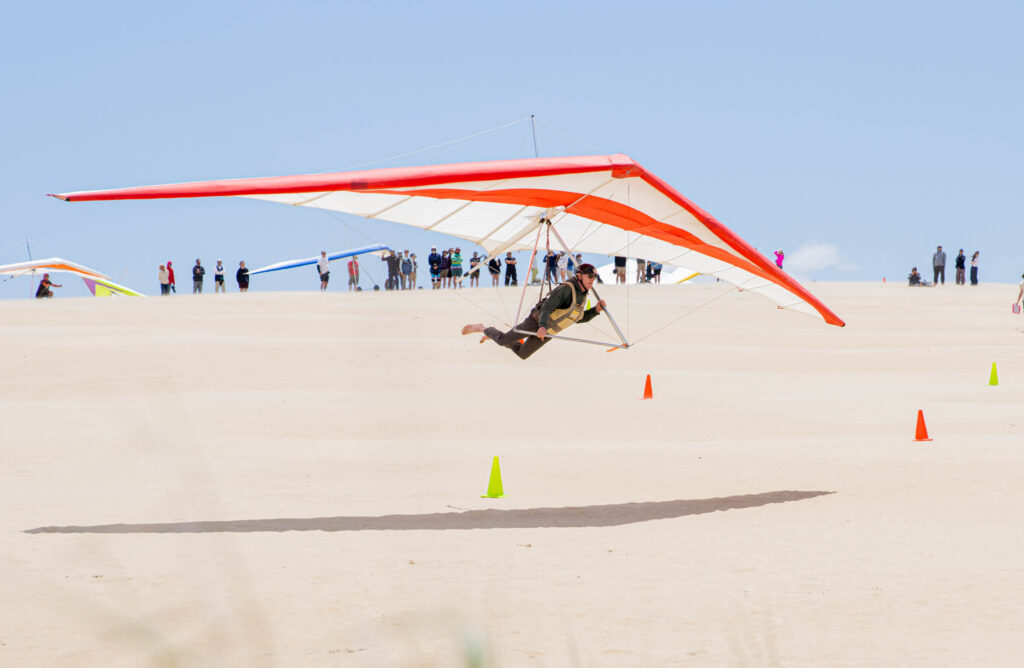
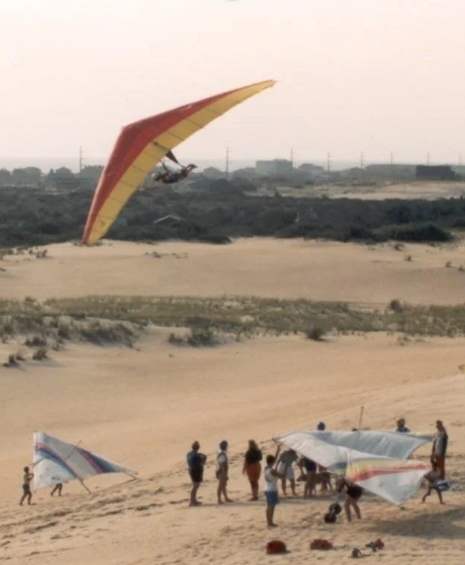
On Saturday, Dr. Peter Busse went hang gliding, followed by tandem hang gliding flights on Sunday. Launching from the towering dunes of Jockey’s Ridge State Park, the experience offered a powerful reminder of the same curiosity and wonder that inspired Lilienthal and the Wright Brothers generations ago.
Standing atop the dunes where aviation history surrounds you, it becomes easy to understand why the Outer Banks continue to inspire pilots and dreamers from around the world.
The Spirit of Flight Lives On
This special weekend served as more than just a historical visit — it became a celebration of innovation, education, and the global aviation community. From Otto Lilienthal’s glider experiments in Germany to the Wright Brothers’ first powered flights in the Outer Banks, and from Rogallo’s hang glider designs to today’s student aviation programs, the spirit of flight continues to evolve through each new generation willing to step off the ground and into the sky.
Ready to experience that feeling for yourself?
Whether you’re inspired by history, adventure, or simply the dream of flying, there’s no better place to begin than the birthplace of flight. Join Kitty Hawk Kites for a hang gliding lesson and discover firsthand why humans have spent generations chasing the skies.
Featured Adventures
Fly at Jockey's Ridge
From Our Store
Shop Online

$60.00
In stock

$75.00
In stock

$45.00
In stock

$136.99
In stock
Related Posts
Related stories and guides
More posts from similar categories, selected near this story's publish date.

Adventures
Published
October 13, 2025

Adventures
Published
October 2, 2025
Adventures
Published
August 14, 2025